
Franchise Vs Starting From Scratch: Which Is Better For You?

Singapore's dynamic entrepreneurial ecosystem continues to expand, with the Global Entrepreneurship Monitor ranking Singapore among the top countries for business creation. However, the critical decision facing aspiring entrepreneurs remains unchanged: should you invest in an established franchise system, or build your own business from the ground up?
Both paths offer distinct advantages and challenges. Understanding the differences—and your own priorities—is essential to making the right choice for your goals, capital, and risk tolerance.
What Is Franchising, and How Does It Differ from Starting from Scratch?
Franchising involves acquiring the right to operate a business using an established franchisor's brand, systems, products, and business model. In Singapore, the franchise landscape includes homegrown success stories and international brands across food and beverage, retail, services, and technology sectors.
Starting from scratch means building your business independently—creating your own brand identity, developing your own systems, and navigating every aspect of business operations without a pre-established framework.
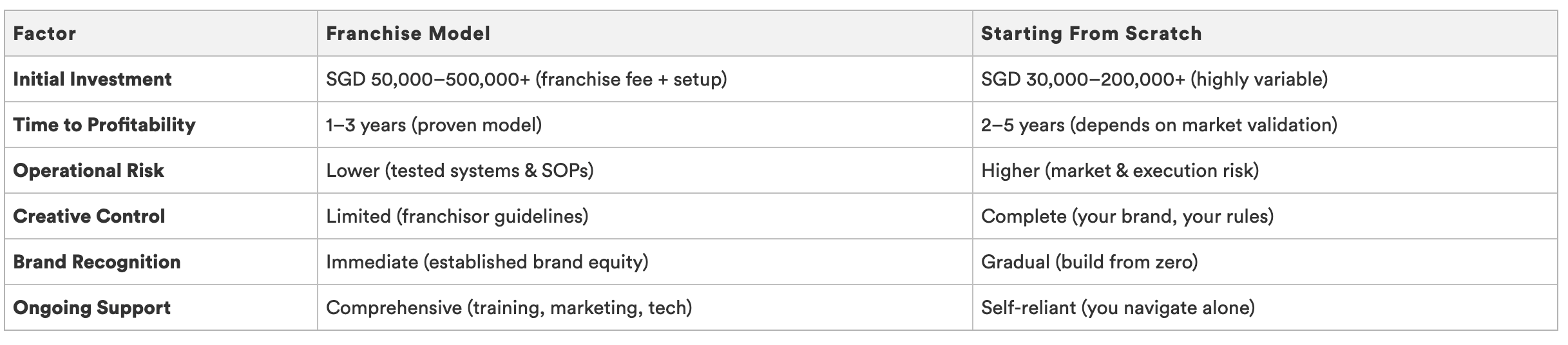
The fundamental trade-off is straightforward: franchises offer reduced risk and faster market entry, but at the cost of initial capital and ongoing operational constraints. Starting from scratch demands more entrepreneurial labour and carries higher risk, but offers complete creative control and potentially higher profit margins.
Franchise vs Starting From Scratch: Side-by-Side Comparison
The Advantages of Franchising a Business
Proven Business Model & Reduced Risk
Franchisors have spent years (often decades) refining their operations, systems, and customer propositions. You inherit the lessons of their success—and avoid their early mistakes. This significantly lowers the risk of business failure compared to independent startups. Established franchise systems generally see higher survival rates than newly launched independent businesses.
Immediate Brand Recognition & Customer Base
Launching under an established brand means customers already know what to expect. This accelerates your path to revenue compared to building brand awareness from scratch. Customers are more likely to visit your outlet on opening day because the brand has credibility and a reputation they value.
Comprehensive Franchisor Support
Most franchisors provide training programmes (initial and ongoing staff development), marketing support (national campaigns, digital strategies, promotional materials), technology systems (POS, inventory management, customer data platforms), operational guidance (site selection, lease negotiation, supply chain setup), and continuous improvement (trend updates, product innovations, best-practice sharing). This support ecosystem accelerates your competency and reduces the learning curve significantly.
Scalability & Standardisation
Once you've launched your first outlet, expanding to a second or third is simpler because the systems are already proven and documented. Consistency across outlets builds brand trust.
The Challenges of Franchising a Business
Substantial Initial Capital Requirement
Franchise fees in Singapore typically range from SGD 50,000 to SGD 500,000+, depending on the brand's positioning and sector. Add to this the costs of fit-out, equipment, initial inventory, and working capital. This upfront barrier excludes many aspiring entrepreneurs and requires careful financial planning.
Limited Creative Freedom
You must adhere to the franchisor's brand guidelines, operational standards, menu/product range, and often pricing strategies. If you want to innovate or adapt to your local market in ways the franchisor doesn't approve, you may face restrictions. This can feel constraining if you're a highly creative entrepreneur.
Ongoing Royalties & Marketing Fees
Franchise systems typically charge royalties (5–10% of gross revenue) paid regularly to the franchisor, marketing fund contributions (2–5% of revenue) for collective brand promotion, and technology or service fees for access to systems and support. These recurring fees reduce your net profitability and remain in place for the entire franchise agreement (often 5–10 years).
Reputation Risk Tied to Overall Brand
Your franchise outlet's success is partly dependent on the franchisor's decisions and the broader franchise system's reputation. If other outlets perform poorly or the brand faces public relations challenges, your business may be affected despite your own operational excellence.
The Advantages of Starting a Business from Scratch
Complete Creative Control
You design your brand identity, choose your target market, set your pricing, develop your product/service offering, and build your company culture exactly as you envision it. This freedom is invaluable if you have a distinctive concept or strong ideas about how you want to operate.
No Profit-Sharing or Royalty Obligations
Every dollar of profit stays in your business (aside from standard taxes and operational costs). You avoid the 5–15% cumulative hit of royalties and marketing fees that franchise outlets pay.
Business Aligned with Personal Values
You control your sourcing, hiring practices, environmental commitments, and social impact initiatives. If ethical sourcing or sustainability is important to you, you're not constrained by franchisor standards.
Stronger Exit Options
If you decide to move on, you can sell your business, its brand, and its systems to an interested buyer. Your brand equity—something you built—has real asset value.
The Challenges of Starting a Business from Scratch
Higher Risk of Failure
Independent startups face significantly higher failure rates than franchise systems. You're testing an unproven model in a competitive market, with no safety net of franchisor support or proven systems. Market research, capital, and execution must all align perfectly.
Time-Consuming & Expensive Start-Up Phase
Building a brand from zero requires months of preparation: market research, concept refinement, legal entity setup (via ACRA registration), securing premises, developing SOPs, hiring and training staff, building marketing foundations, and establishing supplier relationships. This pre-revenue period can stretch 12–18 months or longer.
Navigating Business Complexity Independently
You're responsible for every aspect: licensing (including any sector-specific permits), financial management, HR compliance, tax obligations, health and safety, technology infrastructure, and customer service standards. Without the guidance of a franchisor, you must rely on external advisors (accountants, lawyers, consultants), which adds to costs.
Slow Brand Building
Building brand recognition organically takes time, consistent marketing investment, and word-of-mouth. Unlike a franchise that launches with existing brand equity, you start with zero awareness and must earn customer trust through experience and engagement.
Singapore Context: How Local Factors Shape Your Decision
Singapore's Regulatory Environment
ACRA registration is straightforward for independent businesses, but you'll navigate more compliance requirements on your own (financial reporting, employment standards, sector-specific licensing). SkillsFuture Credit (SGD 500 per year for eligible workers) can help fund training in business management, financial planning, or digital skills. The Enterprise Financing Scheme (EFS) offers government-backed loans up to SGD 6 million for SMEs, potentially more accessible if you have a robust business plan.
Market Density
Singapore's small geographic footprint means the market is saturated in many sectors. Franchise brands benefit from established distribution, but independent startups may struggle to justify the investment if your unique value proposition isn't compelling.
Access to Capital
Singapore has a mature financial ecosystem. Banks, angel investors, and venture capital are accessible if your business model is sound. However, franchise brands may find financing easier because the franchisor's track record provides lenders with confidence.
Singapore Franchise Success Stories
Singapore has produced compelling franchise success stories. Brands like Polar Puffs & Cakes have scaled regionally through franchising, demonstrating how established local concepts can expand beyond a single outlet with the right systems and partner support. Similarly, international franchises have found Singapore a natural launchpad for regional expansion, leveraging the city-state's strategic location and business-friendly environment.
Playmade is a Taiwanese bubble tea brand successfully marketed as an identity that evokes youthfulness, creativity, and innovation. Its brand mission: "Everyone's everyday drink, made by hand using all-natural ingredients."
I Can Read (ICR) is a global English language education organisation. Beyond general English language skills, ICR is renowned for its unique and proven English literacy programme for learners of English and beginning readers.
Kinderland International Education has strong regional brand recognition. For over 40 years, Kinderland has established itself as a trusted regional preschool brand with an international footprint across eight Asia-Pacific countries and over 60 centres.
Shihlin Taiwan Street Snacks Founded in 2003 with a vision to bring authentic Taiwanese street food to the world, Shihlin Taiwan Street Snacks today stands as the #1 Taiwanese street food quick-service chain, offering an array of authentic delights.
Ya Kun From its humble beginnings as a modest coffee stall in the 1940s, Ya Kun has become synonymous with kaya toast and fragrant coffee and tea, enjoyed in a warm and cosy atmosphere. Today, Ya Kun continues to delight loyal fans and win new converts.
How FLA (Singapore) Helps You Decide
FLA (Singapore) is Singapore's central hub for franchise and licensing knowledge. Whether you're leaning toward franchising or building independently, FLA (Singapore) provides resources and support at every stage.
The FLA Franchise Directory lets you browse curated franchise opportunities across food, retail, services, and technology sectors. Each listing includes franchisor profiles, investment ranges, and support offerings—your first stop to explore and compare brands.
The WSQ Franchise & Business Ownership (Synchronous E-Learning) are accredited by SkillsFuture Singapore. These programmes equip you with the framework to evaluate franchise opportunities, understand franchise agreements, manage operations, and apply financial management strategies. Completing a WSQ course may also improve your financing prospects with lenders.
FLA (Singapore) also hosts regular networking events, workshops, and market briefings where you can connect with franchisors, other franchisees, and service providers—gaining firsthand insights into franchise opportunities and challenges.

FLA (Singapore) also hosts regular networking events, check out the FLA calendar.
Which Path Is Right for You? A Decision Framework
Choose Franchising If You:
- Prefer a proven, lower-risk business model with clear pathways to profitability
- Value hands-on support and don't want to navigate all aspects independently
- Have moderate capital (SGD 50,000–500,000+) and want faster time-to-revenue
- Are willing to prioritise brand guidelines over creative experimentation
- Prefer leveraging an existing brand and customer base from day one
Choose Starting from Scratch If You:
- Have a distinctive, well-validated business concept you're passionate about
- Prioritise creative control and building your own brand identity
- Are willing to invest 2–5 years before reaching sustained profitability
- Have the capital and appetite to navigate regulatory, operational, and marketing complexities independently
- Prefer keeping all profits and owning your business systems outright
Middle Ground: Franchise Conversion
Some entrepreneurs start independently, build a successful single location with proven systems, and then franchise their concept to scale. This hybrid approach lets you test your model before expanding via franchisees—a path that FLA (Singapore) also supports with dedicated training and advisory resources.
Key Takeaways
- Franchising reduces risk and accelerates time-to-revenue but requires substantial upfront capital and ongoing royalties.
- Starting from scratch offers creative control and full profit retention but demands more time, capital, and navigational effort.
- Singapore's business environment supports both paths—EFS loans, SkillsFuture training credits, and a mature financial ecosystem reduce friction for either model.
- FLA (Singapore) resources—the Franchise Directory, WSQ courses, and networking opportunities—empower you to make an informed decision tailored to your circumstances.