
The Definitive Guide to Franchise Costs in Singapore (2026)

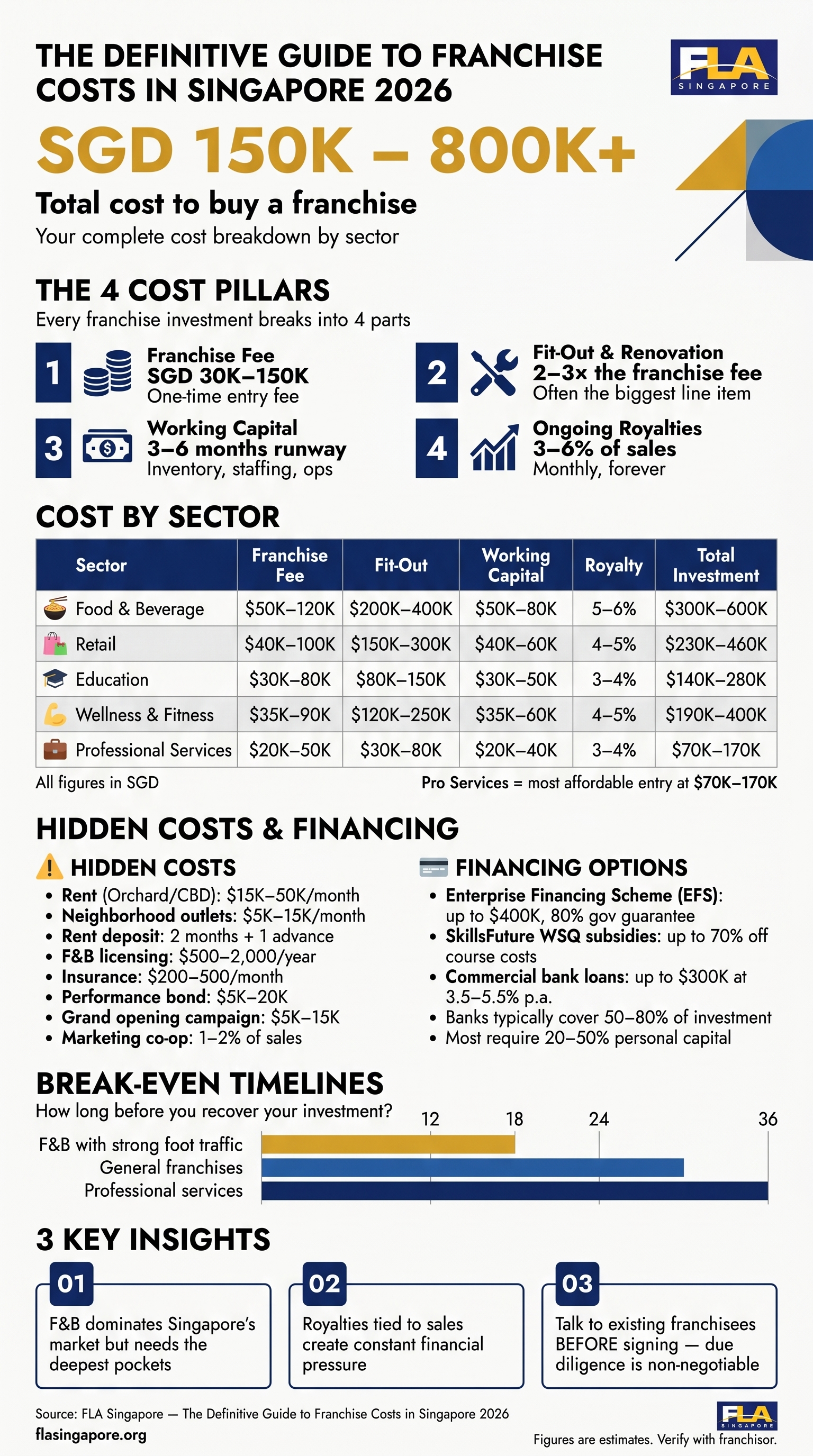
For aspiring entrepreneurs evaluating franchise investment in Singapore, understanding the true cost of ownership is foundational. Franchising offers a proven business model and established brand recognition—but it requires clear financial planning. The total cost to buy a franchise in Singapore typically ranges from SGD 150,000 to SGD 800,000+, depending on sector, brand maturity, and location. This guide breaks down every cost component and equips you with the framework to assess franchise opportunities with confidence.
Understanding Total Franchise Cost
When evaluating franchise costs in Singapore, most entrepreneurs focus only on the franchise fee—the upfront payment to the franchisor for the right to operate under their brand. But this is only one piece of the puzzle. The true cost of franchise ownership comprises four distinct components: the franchise fee itself, fit-out and renovation costs, working capital to launch operations, and ongoing royalty fees.
The franchise fee typically ranges from SGD 30,000 to SGD 150,000, depending on brand recognition and market position. Established brands with proven systems command higher fees than newer entrants. However, the franchise fee is often the smallest expense relative to total investment. Fit-out costs—renovating and equipping the outlet to brand standards—often exceed the franchise fee by two to three times. Working capital to cover initial inventory, staffing, and operational expenses until the outlet reaches profitability adds another significant layer. Understanding this full picture prevents undercapitalisation, which is a leading cause of franchise failure.
Sector-by-Sector Cost Breakdown: Real Singapore Context
The cost structure varies significantly by sector. Food and beverage franchises typically require higher capital investment due to equipment and licensing requirements, while professional service franchises may be asset-light. Here is a detailed breakdown by sector with SGD figures:
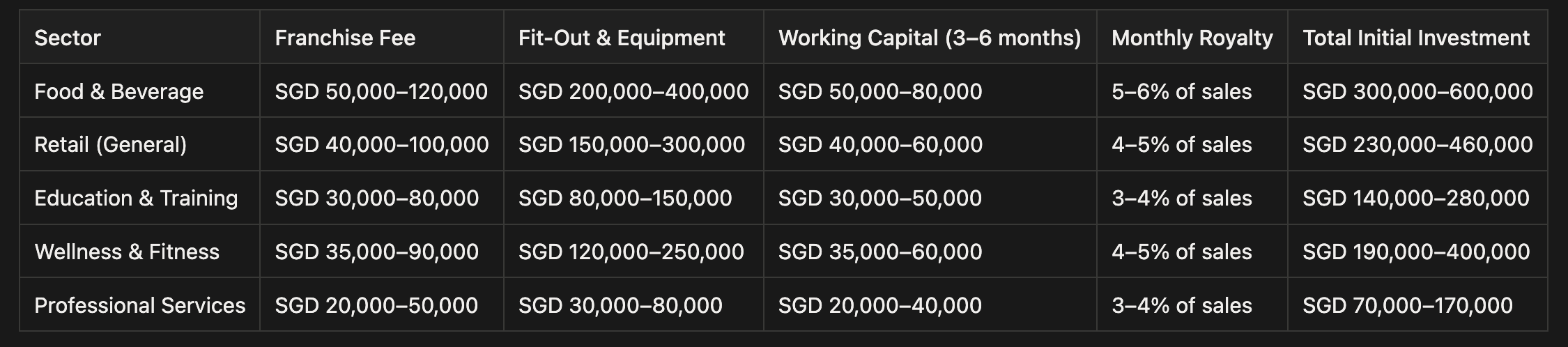
Key insights from this breakdown:
- Food and beverage franchises dominate Singapore's franchise landscape but require the highest capital outlay due to kitchen equipment, licensing (ACRA food safety compliance), and inventory needs.
- Retail and wellness franchises occupy a middle ground, with moderate fit-out costs reflecting smaller footprints or shared spaces.
- Education and professional services franchises are the most accessible entry points for first-time franchisees with limited capital.
- Royalty structures are tied to sales performance, creating ongoing cost pressure—ensure your revenue projections support these percentage commitments.
Hidden and Ongoing Costs Franchisees Often Miss
Beyond the initial investment table, franchisees face several recurring or contingent costs that can strain cash flow if not anticipated:
1. Rental and Lease Deposits
Singapore's retail rental market is competitive. Expect to pay two months' deposit upfront plus one month's advance rent. Premium locations in Orchard, Bugis, or CBD areas command SGD 15,000–50,000 monthly; neighbourhood outlets range from SGD 5,000–15,000. This is separate from your franchise fee and fit-out costs.
Check out our WSQ Franchise Site Selection and Lease Negotiations (FSSLN) for more information about rental and lease
2. Licensing and Compliance
Food and beverage franchisees must obtain a licence from the Singapore Food Agency (SFA) and comply with food safety standards. Licensing costs SGD 500–2,000 and requires annual renewal. Professional services franchises may require industry-specific certifications or registrations, adding SGD 1,000–5,000 to initial expenses.
3. Insurance and Bond
Premises liability insurance, contents insurance, and workers' compensation are mandatory. Budget SGD 200–500 monthly depending on outlet size and sector. Some franchisors require a performance bond (SGD 5,000–20,000) to secure compliance with brand standards.
4. Marketing and Grand Opening
Franchisors typically require franchisees to invest in local marketing for the opening period. Many franchise agreements mandate a co-op marketing fund (1–2% of sales) from month one. Initial grand-opening campaigns often cost SGD 5,000–15,000 for digital and grassroots activation.
5. Training and Ongoing Support Fees
While most franchisors include foundational training in the franchise fee, advanced training modules, additional staff certification, or regional training events may incur separate charges of SGD 1,000–5,000 annually.
Financing Your Franchise Investment
Most franchisees cannot fund the full investment from personal savings. Singapore offers several financing pathways that can reduce your burden:
Enterprise Financing Scheme (EFS)
The EFS is administered by participating banks and offers loans of up to SGD 400,000 for business expansion, including franchise acquisition. The government provides a guarantee of up to 80% of the loan, significantly reducing the lender's risk and lowering your interest rate. Eligibility requires a business track record or proof of franchisee experience.
SkillsFuture Subsidies
If you are transitioning into franchising as a career pivot, SkillsFuture may subsidise up to 70% of the cost of relevant WSQ (Workforce Skills Qualification) courses. Courses such as WSQ Franchise and Business Ownership or WSQ Essentials of Franchise Management equip you with the operational knowledge to reduce risk and improve success rates.
Personal Loans and Equity Financing
Commercial banks offer secured and unsecured franchise loans at competitive rates (currently 3.5–5.5% p.a.) for amounts up to SGD 300,000. If you have business partners, equity financing can spread investment and risk. However, ensure any partnership agreement is formally documented to prevent disputes later.
Franchise Fee Negotiation and Value Assessment
Not all franchise fees are non-negotiable. Particularly for emerging brands or multi-unit expansion arrangements, franchisors may offer fee discounts or rebates tied to performance milestones. Before committing, ask yourself:
- Has the franchisor provided audited financial disclosures? Reputable franchisors supply proforma financial data showing what comparable franchisees have achieved.
- What is included in the franchise fee? Does it cover training, initial inventory, branding materials, technology systems, and grand-opening support?
- Are there references from existing franchisees? Request at least three to five franchisee references and speak to them about actual costs incurred versus projections.
- What is the franchisor's track record? How many franchisees are currently in the network, and what is the churn (closure) rate?
These due diligence steps may take time, but they are invaluable protection against underfunded ventures or misrepresented opportunities.
Real Franchise Examples in Singapore
Singapore's franchise market includes mature, successful brands across multiple sectors. Old Chang Kee — a homegrown heritage brand — operates a growing franchise network with multiple outlets across Singapore. Their franchise model exemplifies how local brands can scale through structured franchising. Similarly, 7-Eleven operates through a well-established network with defined cost structures and proven support systems.
Beverage franchises like LiHO TEA have capitalised on Singapore's bubble tea trend, offering franchisees a capital-efficient model with strong brand equity in the regional market. On the premium end, iJooz operates a juice and wellness franchise targeting health-conscious consumers, commanding higher unit economics but also higher initial investment.
These brands are members of FLA (Singapore), the central industry body, and are held to governance standards around transparency and franchisee support. When evaluating franchise opportunities, prioritise brands affiliated with FLA (Singapore) membership, which indicates adherence to industry best practices.
How FLA (Singapore) Supports Your Franchise Journey
FLA (Singapore) provides critical resources to help you navigate franchise investment with confidence. The FLA Franchise Directory lists vetted franchise opportunities across Singapore, filterable by sector, investment level, and franchisor track record. This curated database allows you to benchmark costs and identify brands aligned with your capital and skills.
If you lack formal franchise experience, WSQ Franchise and Business Ownership and WSQ Essentials of Franchise Management courses provide structured grounding in franchise operations, legal compliance, financial modelling, and franchisee responsibilities. These courses are funded under SkillsFuture, reducing your out-of-pocket cost. Graduates gain confidence to assess franchise opportunities critically and avoid costly mistakes.
FLA (Singapore) also hosts networking events, workshops, and franchise expos where you can meet franchisors, existing franchisees, and service providers who support franchise operations.
Conclusion: Invest with Eyes Open
Franchise costs in Singapore are substantial but justified by the proven systems, brand equity, and support networks franchises provide. Your investment typically ranges from SGD 150,000 to SGD 800,000+, with food and beverage at the higher end and professional services at the lower. The true cost extends beyond the franchise fee to include fit-out, working capital, licensing, insurance, and ongoing royalties.
Success in franchising depends on thorough due diligence, realistic financial projections, and choosing a brand and franchisor aligned with your skills and capital. Singapore's financing schemes—the Enterprise Financing Scheme and SkillsFuture subsidies—can ease your financial burden. Seek guidance from FLA (Singapore), speak to existing franchisees, and invest in training before committing capital.
FAQ
Q: What is the cheapest franchise to buy in Singapore?
A: Professional services franchises (consulting, coaching, training) are often the most affordable, with total investments starting from SGD 70,000–150,000. These models typically require lower fit-out costs and minimal inventory. However, cost is not the only factor—choose a franchise aligned with your skills and market demand, regardless of price.
Q: Can I finance my entire franchise investment through a bank loan?
A: Most banks will finance 50–80% of your total franchise investment, requiring you to contribute 20–50% as personal capital or equity. The Enterprise Financing Scheme (EFS) offers government-backed guarantees of up to 80%, improving loan availability. Speak to participating banks such as DBS, OCBC, and UOB about franchise-specific loan products.
Q: Are franchise royalties tax-deductible in Singapore?
A: Yes, royalty payments are typically treated as a business expense and are tax-deductible, reducing your taxable income. Consult a certified public accountant (CPA) or tax advisor to ensure proper classification and documentation for IRAS (Inland Revenue Authority of Singapore) compliance.
Q: How long does it take to break even on a franchise investment?
A: Most franchises reach break-even within 18–36 months, depending on sector, location, and operational efficiency. Food and beverage franchises with strong foot traffic may break even in 12–18 months. Professional services franchises may take 24–36 months due to longer client acquisition cycles.